Eight Reasons Your Posts Get No Engagement and How to Fix Each
Low likes and comments almost always trace back to one of these eight fixable problems, not bad luck.
When a post flops, it feels random. It usually isn't. Most dead posts share one of eight problems, and each one has a specific fix you can apply before you post again.
1. The first line gives nothing away
If the opening sentence is a throat-clear ("So I've been thinking about...") or a brand-speak wind-up, people scroll before they know why they'd care. The first line has to work alone, as if it's the only line anyone will read.
- Fix: Rewrite the opening as a claim, a question, or a number. "Most posts die in the first line" beats "Here are some thoughts on engagement."
If you want a stock of openings that work, see 10 hook patterns for the first line of any social post.
2. There's no reason to stop and no reason to save
A post that only states a fact, with no promise and no next step, reads as filler. People engage with posts that feel useful enough to act on or come back to.
- Fix: Structure the post around a promise, a quick piece of proof, and one clear next step. It doesn't need to be long, just complete.
The full structure is in the promise, proof, next step formula for posts people save.
 Want this written for your brand?
Fullmedia Alchemist drafts posts from your own website and brand facts, so nothing is made up. Start free, no card.
3. The format doesn't match the idea
Dense advice crammed into a single image gets skimmed and lost. A simple idea stretched across ten carousel slides gets abandoned halfway. Mismatched format is one of the quietest killers of engagement because the post looks fine, it just isn't shaped right.
- Fix: Ask what the idea actually needs. A list of steps usually wants a carousel. A single sharp opinion usually wants one image. A nuance-heavy argument might want a thread instead of a picture at all.
Compare the two directly in carousel or single image? How to choose for each network, and see non-picture options in not every post is a picture: text, thread and poll versions.
4. You're posting the same thing everywhere, unchanged
A caption written for LinkedIn rarely works pasted into Instagram or X. The tone, the length, and what counts as a strong opening are different on each network. Copy-pasting signals low effort even when the idea is good.
- Fix: Keep the core idea, rewrite the wrapper for each network. See one idea, many networks: reshape it, don't copy-paste it and every network gets its own caption now.
5. The voice sounds like nobody in particular
Generic, safe, corporate-sounding captions blend into the feed. People engage with posts that sound like they came from an actual person with actual opinions, not a brand committee.
- Fix: Define three words that describe how your brand talks and three things it never says, then check your next five posts against that list.
Use the quick exercise in define your brand voice in ten minutes, and see examples in write captions that sound like you, not a robot.
6. You never give people a reason to comment
A post that only states something leaves nothing for a reader to add. Comments usually come from a question, a choice, or a mild disagreement the post invites.
- Fix: Close with a specific question, not a generic one. "What would you add?" is weak. "Which of these would you cut first?" gives people something concrete to answer.
For how to do this without sounding like you're begging for likes, see polls and questions that don't sound desperate for likes.
7. Nobody replies when people do engage
A comment with no response often gets no follow-up comment either. Engagement compounds when the brand treats the comment section as part of the post, not an afterthought.
- Fix: Build a short reply pass into your routine. Even one or two thoughtful replies per post, quickly, signals the post is worth engaging with.
More on this in reply to comments and DMs like it's part of the job.
8. You're guessing instead of checking what already worked
Without a record of which formats and networks performed, every post is a fresh guess. Over time, patterns show up: certain topics do better as carousels, certain networks respond better to questions than statements. If you're not tracking that, you're ignoring free information.
- Fix: Keep a simple log of saved results by network and format, and check it before planning new posts.
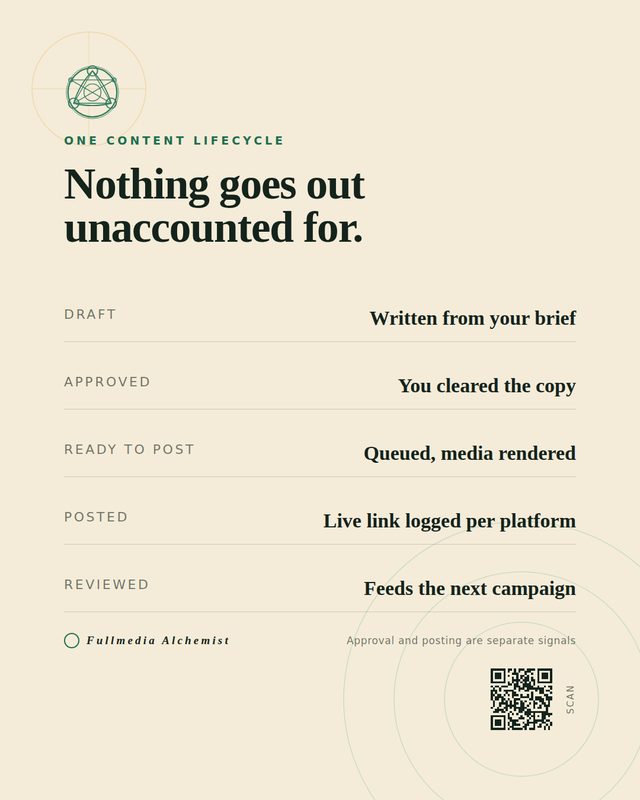
Fullmedia Alchemist's Content tool keeps this automatically: when you save results from posts, a table called "What worked where" shows which networks and formats performed best, so you can lean into what's already proven instead of guessing again. See what worked where: single image or carousel, per account.
Before you blame the algorithm
Run your last five posts against this list. Most dead posts fail on two or three of these points at once, which is also why fixing just one of them often isn't enough.
Put it together with a quick audit
Rather than fixing posts one at a time, it's faster to review a small batch together and look for the repeated pattern. A short, structured look at your last twenty posts will usually surface which two or three of these eight problems are costing you the most.
Use a social media audit in seven questions about your last twenty posts to run that check before your next planning session.
Turn your brand into a week of posts.
The Free plan includes 30 credits a month. No card.