The Content Calendar Columns That Actually Matter For Client Work
A client content calendar needs fewer pretty colors and more columns that answer who approved what, and when it goes live.
Most content calendar templates are built to look organized, not to answer the questions a client or a teammate will actually ask. Here are the columns that earn their place, and the ones you can drop.
Start with the questions people ask you
Before you open a spreadsheet, think about what you get asked mid-month. It is rarely "what's the font on the graphic." It is usually one of these:
- Did the client approve this yet?
- What day does this actually go live?
- Which post was that click or comment about?
- Who's covering this if I'm out?
- Did we already post something like this?
Every column in your calendar should trace back to one of those questions. If it doesn't, it's decoration.
The columns that matter
- Client / brand. Obvious if you run one account, essential the moment you run two. Even solo-client agencies should add this now, because it saves a painful rebuild later.
- Publish date and time. Not "week of." The actual day. Vague dates are how two posts land on the same morning and three days go empty.
- Network. One row per network, not one row per idea. A single topic going to LinkedIn, Instagram and X is three rows, because each needs its own shape and sometimes its own timing. See one idea, many networks for why copy-pasting the same caption everywhere underperforms.
- Pillar or theme. A short tag (education, proof, offer, behind the scenes) so you can glance down the column and see if one theme is crowding out the others. If you haven't settled on pillars yet, this piece on choosing four is a fast way to do it.
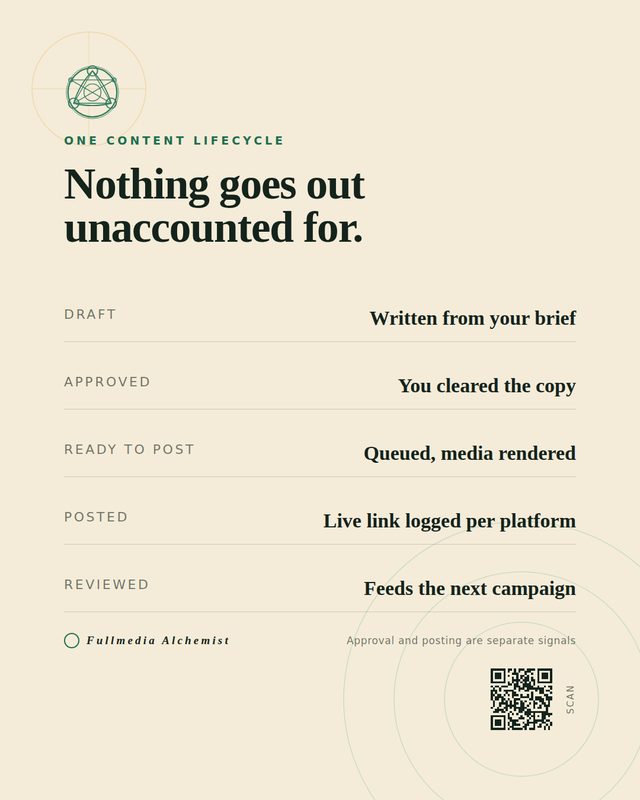
- Status. Draft, in review, approved, scheduled, posted. Four or five plain words, nothing fancier. This single column kills more "wait, did we post this?" messages than anything else on the sheet.
- Approver and approval date. Name and date, not just a checkbox. When a client asks why something went out, or didn't, you want a paper trail that took two seconds to fill in at the time.
- Link or asset location. Where the final caption and image actually live. A calendar full of "see Drive" with no link is not a calendar, it's a promise to go searching later.
- Tracked link, if used. If a post points somewhere, note whether the link is tagged so you can match clicks back to the exact post later. See tagged links in Content and Reach for how that pairing works.
- Notes or sensitivity flag. One line for anything that needs a second look, a regulated topic, a seasonal tie-in, a client's pet peeve. If you post in categories like alcohol, gambling, crypto or supplements, flag it here so review doesn't get skipped; the posting rules that matter covers what tends to trip people up.
 Want this written for your brand?
Fullmedia Alchemist drafts posts from your own website and brand facts, so nothing is made up. Start free, no card.
Columns you can usually skip
Some popular calendar columns look useful but rarely get used after week one:
- Hashtag list. Fine to store, but it belongs in the brief or brand settings, not a fresh cell every single row.
- Engagement prediction. Nobody checks these against reality, and guessing in advance just adds noise.
- Color-coded themes with no legend. If you need a key to remember what blue means, the color isn't doing its job.
- A separate "idea" tab disconnected from the calendar. Ideas that live outside the sheet tend to die outside the sheet. Keep a lightweight ideas column instead, even a one-word placeholder is enough to seed a slot. For quick fill-ins when a week looks thin, 25 post ideas a small business can use this week is a fast reference.
A simple layout
| Client | Date | Network | Pillar | Status | Approver | Link |
|---|---|---|---|---|---|---|
| Acme Co | Tue 14 | Proof | Approved | J. Lee, 10th | drive link | |
| Acme Co | Tue 14 | Proof | Scheduled | J. Lee, 10th | drive link | |
| Acme Co | Thu 16 | X | Education | Draft | pending | drive link |
Seven columns, one row per network, status always visible at a glance. That's the whole system. Everything else is a nice-to-have you can add once this core is solid.
Keep the brief separate from the calendar
The calendar tracks when and where. It should not also try to hold tone, offer details or what never to say, that belongs in a brief you fill out once per post or once per campaign. If you don't have a format for that yet, the one-page content brief template pairs well with this calendar: the brief holds the "what," the calendar holds the "when and did it happen."
Where Fullmedia Alchemist fits
If you're running this calendar for several clients, Fullmedia Alchemist's Content tool keeps each brand's facts, tone and colors separate so posts don't bleed between accounts, and a "What worked where" table shows which networks and formats performed best from the results you save, so your pillar column stops being a guess.
Review it monthly, not just daily
A calendar that only gets checked row by row misses patterns. Once a month, scroll the status column top to bottom and look for bottlenecks: posts stuck in "in review" for a week, one network getting skipped, one pillar dominating. That monthly scan is also the right moment to pull together what belongs in a client report, since the calendar is often where the raw material for that report already lives.
Turn your brand into a week of posts.
The Free plan includes 30 credits a month. No card.